


Australia is experiencing a construction boom across cities and regional hubs, with new housing, infrastructure, hospitals, schools, and renewable energy projects underway or planned. However, there is a significant problem: a shortage of skilled workers. Nearly 85% of employers report skills gaps in the building and construction sector. This shortage creates a real opportunity for international students and career changers to gain qualifications that lead directly to jobs.
Building and construction courses in Australia are job-focused, skills-based, and designed to prepare you for the workforce quickly typically within 6 months to 2 years. These programs emphasize practical training, industry tools, safety standards, and government-recognized qualifications valued by employers.
Construction hiring prioritizes skills over theory safe operations, following plans, coordinating teams, communicating clearly, and delivering quality work. Due to workforce shortages, employers are actively seeking trained people now more than ever.
Several factors increase demand for construction skills:
As a result, construction skills are highly sought after in 2026 not just desirable but essential.
International students often worry about:
Construction courses excel on both fronts when they include strong practical training aligned with industry needs.
Construction is broad; you can choose pathways matching your interests.
1) Certificate-Level Courses
Ideal for quick entry or trade-adjacent roles covering:
Best for: Foundations or entry-level roles with faster completion times.
2) Diploma & Advanced Diploma
Focuses on supervision, coordination, estimating support including:
Best for: Job-ready candidates targeting supervisory or coordination roles.
3) University Degrees
For those aiming at professional roles like:
Longer duration but suited for advanced commercial roles with higher responsibility.
Possible job roles include:
These positions vary by project scale and qualification level but all require practical knowledge gained during study.
Consider your preferences:
Also check:
Despite shortages, employers maintain standards. They want candidates who demonstrate:
Construction courses provide structured proof that you’re prepared for real work environments.
Choosing the right course can be overwhelming. Global Select supports international students by offering:
They help reduce risks associated with choosing unsuitable programs. Visit Global Select for personalized advice.
A common pathway includes:
Progress depends on individual goals and employer opportunities.
If you want a career path that is:
Then building and construction courses are an excellent choice this year.
Are these courses worth it? Yes ongoing demand plus employer-reported skill shortages make them valuable investments if paired with practical training.
How long do they take? Usually between 6 months (certificates) up to 2 years (diplomas). Degrees take longer.
What jobs can I get? Roles include site supervisor (entry-level), project coordinator, estimator assistant, contracts administrator support, quantity surveyor (degrees).
Difference between certificate/diploma/degree
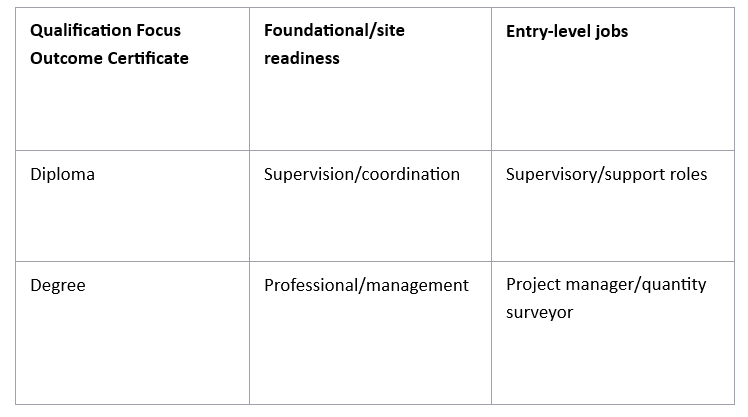
Do courses include practical training? Most vocational programs do verify before enrolling.
Can Global Select help me choose? Yes they provide expert guidance from course selection through visa assistance ensuring your study aligns with career goals.
Studying building and construction in Australia offers strong employment prospects backed by real industry demand. With practical training pathways available from certificates through degrees and expert support from services like Global Select it’s an ideal time to build a rewarding career foundation in this sector.

This blog offers a quick guide on how to apply for scholarships—starting with researching options, preparing documents, writing a strong personal statement, and submitting your application on time. It also highlights the importance of following up after applying. Plus, expert help is available to support students every step of the way, especially those aiming for top universities.

Australia is acknowledged as one of the world’s leaders in the provision of agricultural education with programs that include up-to-date aspects of farming, production practices and agri-business.
.png)
If you're an international graduate in Australia feeling a bit overwhelmed about stepping into the job market, let me tell you—you're not alone. Transitioning from student life to the professional world can be challenging, but there’s an amazing solution to help you bridge that gap: the Professional Year (PY) Program.
| Course | Bachelor’s Degree | Master’s Degree | Requirements or Considerations | English Language Proficiency (IELTS/TOEFL) | Tuition Fees (per year for international students) | Top Universities |
|---|---|---|---|---|---|---|
Nursing | 3 years | 1-2 years | Clinical placements required; may need specific health immunizations. | Minimum IELTS 6.5; TOEFL 79-93. | AUD $30,000 - $45,000 | University of Sydney, University of Melbourne, Monash University |
Information Technology | 3-4 years | 1-2 years | May require programming skills or prior coursework in IT. | Minimum IELTS 6.5; TOEFL 79-93. | AUD $30,000 - $50,000 | Australian National University, University of New South Wales, University of Melbourne |
Accounting | 3 years | 1-2 years | Need to meet accreditation standards by professional bodies. | Minimum IELTS 6.5; TOEFL 79-93. | AUD $30,000 - $40,000 | University of Melbourne, University of Sydney, University of Queensland |
Engineering (various fields) | 4 years | 1-2 years | Strong background in mathematics and physics required. | Minimum IELTS 6.5; TOEFL 79-93. | AUD $35,000 - $45,000 | University of New South Wales, University of Sydney, Monash University |
Social Work | 4 years | 1-2 years | Practical experience or placements required. | Minimum IELTS 7.0; TOEFL 94-101. | AUD $28,000 - $40,000 | University of Melbourne, University of Sydney, University of Queensland |
Education (various fields) | 4 years | 1-2 years | A police clearance and working with children check required. | Minimum IELTS 7.0; TOEFL 94-101. | AUD $28,000 - $35,000 | University of Melbourne, University of Sydney, Monash University |
Psychology | 3 years | 1-2 years | Requires strong research and psychological theory understanding. | Minimum IELTS 7.0; TOEFL 94-101. | AUD $30,000 - $45,000 | University of Sydney, University of New South Wales, University of Queensland |
Occupational Therapy | 3-4 years | 1-2 years | May require pre-registration or relevant clinical experience. | Minimum IELTS 7.0; TOEFL 94-101. | AUD $30,000 - $45,000 | University of Queensland, University of Sydney, Curtin University |
Architecture | 3-4 years | 2 years | Includes technical and creative coursework, portfolio may be required. | Minimum IELTS 6.5; TOEFL 79-93. | AUD $35,000 - $50,000 | University of Sydney, University of Melbourne, Monash University |
Medicine and Health Sciences | 5-6 years | 2-4 years | Highly competitive entry, includes clinical placements and internships. | Minimum IELTS 7.0; TOEFL 94-101. | AUD $45,000 - $70,000 | University of Melbourne, University of Sydney, Australian National University |
| State/Territory | Subclass 190 (Skilled Nominated Visa) | Subclass 491 (Skilled Work Regional (Provisional) Visa) |
|---|---|---|
| New South Wales (NSW) | Required for some occupations | Required for some occupations and regions |
| Victoria (VIC) | Required | Required |
| Queensland (QLD) | Not typically required, conditions apply | Required for some occupations and regions |
| South Australia (SA) | Not typically required, conditions apply | Required for some occupations and regions |
| Western Australia (WA) | Not typically required | Not typically required |
| Tasmania (TAS) | Not typically required, conditions apply | Not typically required, conditions apply |
| Northern Territory (NT) | Not typically required | Not typically required |
| Australian Capital Territory (ACT) | Required, uses Matrix system | Required, uses Matrix system |
Claim your
from us!

Copyright © 2024. Global Select Education and Migration Services. All Rights Reserved. MARN: 2217810, 2418520 | ABN: 81 634 159 292